
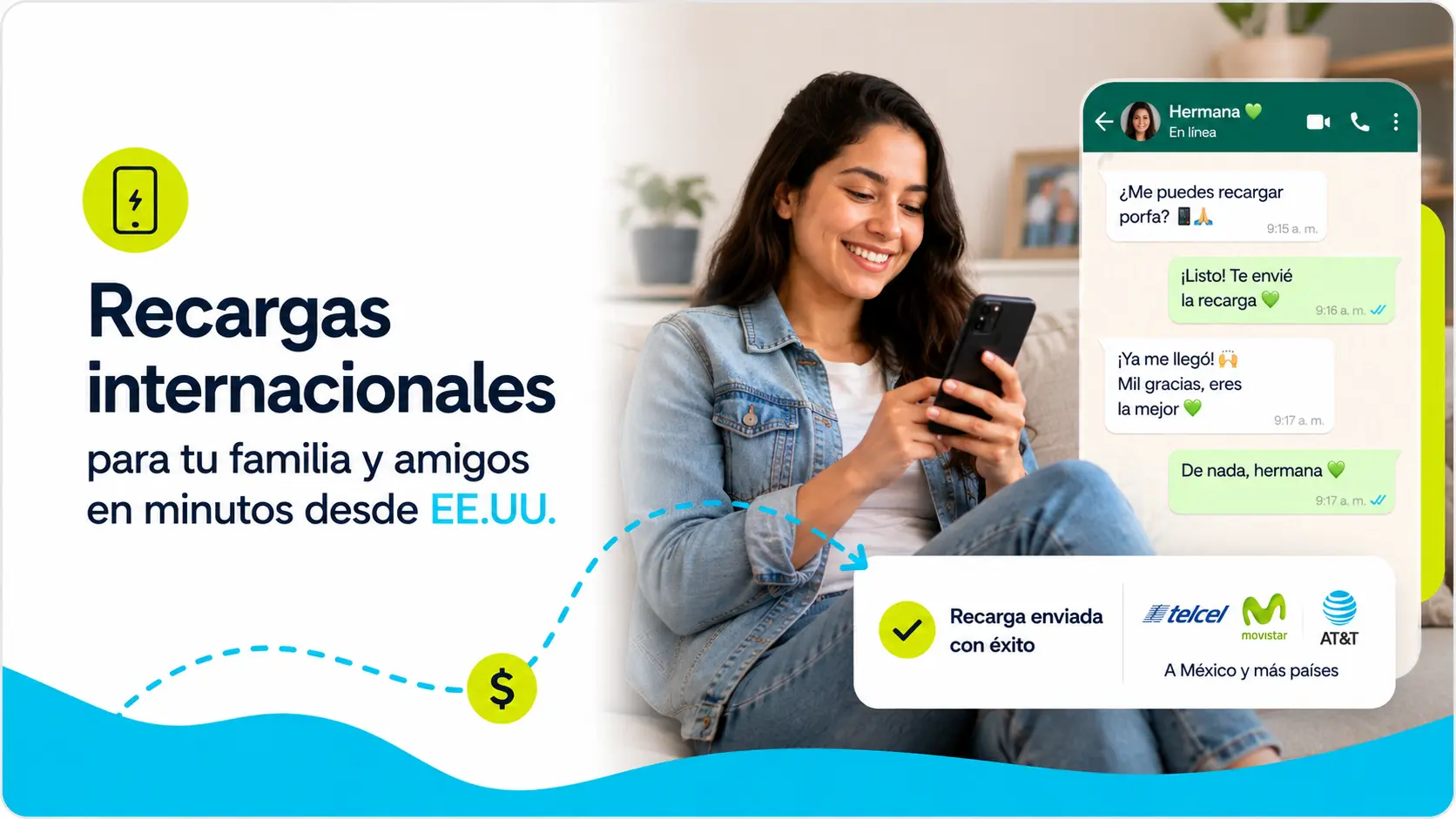
In most Latin American countries, the majority of mobile lines are prepaid, not on a contract. That means that for millions of families, losing signal or data is as simple as running out of balance, and a top-up from the US can fix it in minutes. An international top-up lets an immigrant in the United States pay for their family's phone balance in Latin America straight from their own phone, without the money ever passing through the recipient's hands.
When your mom runs out of balance, it's not just a technical inconvenience. It's not being able to answer your call. It's your child not being able to tell you they got to school safely. It's that anxiety of calling and calling with no answer, not knowing if it's the signal, the phone, or whether something happened. A top-up solves exactly that problem, right when it's most urgent.
This guide covers everything you need to know about international top-ups: what they are, when they make more sense than sending cash, how they work step by step, what to expect depending on your family's country, what the services available today really cost, and how to choose the right provider.
1. What an International Top-Up Is and When It Makes Sense
An international top-up is the purchase of balance (in several countries also called airtime), minutes or data for a phone number in another country, paid for from the US. In Spanish it's called a recarga, and it's also known as a mobile top-up. Unlike a money transfer, where the beneficiary receives cash, a bank deposit or a digital wallet balance they can use however they want, a top-up has only one possible destination: the phone plan. It can't be withdrawn as cash, it can't be transferred to someone else, and it can't be spent on anything else.
That restriction is precisely what makes a top-up useful in certain situations. It's not a substitute for a remittance: it's a different tool for a different problem.
When a top-up makes more sense than sending cash
- When your immediate priority is for your family member to be able to stay in touch, not to have money available to spend.
- When the amount is small and doesn't justify the fee or the time of a full transfer (topping up $10 or $15 of balance, for example).
- When you want to be sure the money is used exactly for what you sent it for, without being diverted to another expense.
- When your family member has no active bank account or nearby cash pickup point, but does have a phone with a prepaid line.
When a money transfer is still the best option
- When your family member needs the money for variable expenses: food, rent, medicine, transportation.
- When the amount is significant and a top-up doesn't cover the real need.
- When you prefer that your family member be in control of deciding what the money is used for.
In practice, many senders use both tools together: they send money for the month's expenses and top up the phone separately when the signal drops at a critical moment. If you're still unsure between the two options, read Mobile Top-Up or Money Transfer: Which to Choose?. See the complete guide to money transfers and remittances if you want the full comparison of methods for sending cash to your family.
2. How an International Top-Up From the US to Latin America Works
The mechanism of an international top-up is simpler than that of a remittance, precisely because it involves neither banks nor cash pickup networks. The money doesn't travel from a money transfer service provider to a correspondent bank and from there to an account or a payout point. Instead, the payment goes straight from the top-up service to the mobile carrier in the destination country, which credits the balance to the beneficiary's line.
The typical steps of an international top-up
To send top-ups with Félix, you need to have completed at least one money transfer first.
- Open WhatsApp and type "recarga" (Spanish for top-up) in your chat with Félix.
- Enter your family member's international phone number, including the country code (for example, +52, +57). Félix automatically detects the country and the carrier from the number. Check every digit with your family member before continuing: a wrong number usually credits the balance to another line, with no possibility of a refund.
- Choose the type of top-up: balance (airtime), a bundle or data, depending on what your family member's carrier offers and what they need.
- Choose the top-up amount. Today you can top up up to $20 per top-up, make up to 2 paid purchases per day (top-ups and bill payments count together) and send up to 2 top-ups per day to the same number.
- Review the summary before you confirm. Check the phone number, the carrier and the amount: once the top-up is processed, there's no way to correct an error in these details.
- Confirm and pay with a debit or credit card issued in the US (American Express and cash are not accepted).
- Félix sends you a confirmation on WhatsApp once the top-up has been processed.
- Done. The balance is credited to your family member's line, usually within minutes. The carrier sends your family member a message confirming the top-up.
What you need to have ready before you top up
- Your family member's complete and correct phone number, with the country code.
- Confirmation of which carrier your family member uses (Telcel is not the same as Movistar, and a top-up made to the wrong carrier usually can't be corrected or refunded).
- The amount or bundle your family member really needs: balance, data or a bundle.
Unlike a money transfer, which involves at least the sender, the provider, a correspondent bank and the beneficiary, an international top-up involves only two active parties: the buyer in the US and the phone carrier in the destination country. That generally makes the process faster, but it also means a mistake in the phone number is much harder to reverse than a mistake in a bank account.
This is the same mechanism Félix follows on WhatsApp: you type "recarga", enter your family member's number, choose the type of top-up and the amount, and confirm the payment. You can also start from the Félix international top-ups page.
3. Top-Ups by Country: Carriers and What to Expect
Each country has its own carrier landscape, and not all of them offer the same types of top-up (balance, bundles, data). Before you top up, confirm your family member's exact carrier with them: topping up the wrong carrier is the most common mistake and the hardest to fix.
| Country | Main carriers | What to expect |
|---|---|---|
| Mexico | Telcel, AT&T, Bait, Unefon, Movistar | The market with the most carriers in the region; most top-up services offer balance, bundles and data. |
| Guatemala | Tigo, Claro | Wide coverage in urban areas and much of the interior; combined minutes-and-data bundles are common. |
| Honduras | Tigo, Claro | Two carriers dominate the market; confirm which one your family member uses before topping up, since many numbers can be ported between the two. |
| El Salvador | Claro, Tigo, Digicel, Movistar, Red | El Salvador uses the dollar as its official currency, which makes it simpler to compare prices across top-up services. |
| Nicaragua | Claro, Tigo | A market concentrated in two carriers; the availability of data bundles varies more than in neighboring countries. |
| Colombia | Claro, Tigo, Movistar | Good competition among carriers; prepaid plans often include combos of data, minutes and social media. |
| Dominican Republic | Claro, Altice, Viva | Three active carriers; confirm which one your family member uses, since Altice keeps the Orange brand in part of its offering. |
| Costa Rica | Claro | If your family member uses a carrier other than Claro, confirm before paying that the top-up service covers it. |
| Peru | Movistar, Bitel, Entel | Three carriers compete actively in Peru's prepaid market; confirm which one your family member uses before topping up. |
Balance top-ups vs. bundles and data: the types of top-ups available
Depending on the carrier, top-up services offer balance (your family member decides what to use it for: calls, messages or data, according to their carrier's rules), bundles, also called denominations (a set amount of data, minutes or a combination, usually at a different price than the equivalent balance), and data. Not every carrier offers all three. Amounts appear as options in local currency, and some carriers let you type an amount within a range. Ask your family member which they prefer: some carriers give more value per dollar in a bundle than in plain balance, and this changes depending on the carrier and the country.
Today, top-ups on WhatsApp, by typing "recarga", are available only in the countries in the table above. Brazil isn't available for top-ups for now, although you can send money there. If your family member's country isn't in the table, you can't top up their phone with Félix today. The list of countries where you can send money applies only to money transfers, not to top-ups.
4. Top-Up vs. Sending Money to Latin America: How to Decide
This is the real question behind the search "should I send money or top up their phone?" There's no single answer: it depends on what your family member needs at that specific moment. For a deeper look, read Mobile Top-Up or Money Transfer: Which to Choose?.
| Criterion | International top-up | Money transfer |
|---|---|---|
| Control over use | Can only be used for the phone plan | The beneficiary decides what to spend it on |
| Needs a bank account or ID | No, just an active phone number | Depends on the method: not for cash or a wallet; yes for a bank |
| Typical speed | Generally minutes | Minutes to 24 hours, depending on the method |
| Reversibility of a mistake | Very low: a wrong number can almost never be recovered | Higher: an account or name error can be corrected before pickup |
| Best for | Immediate communication needs, small amounts | Variable expenses: rent, food, health, medium or large amounts |
Can I top up my family's phone with Félix?
Yes. Today you can send international top-ups with Félix directly on WhatsApp: type the word "recarga" in your chat with Félix and Félix walks you through it step by step. You can also start from the Félix international top-ups page. You pay with a debit or credit card issued in the US, and today the maximum is $20 per top-up, with up to 2 paid purchases per day (top-ups and bill payments count together).
If you'd rather talk to a person first, type "hablar con agente" (Spanish for "talk to an agent").
Félix lets you send international top-ups directly on WhatsApp today: just type "recarga" in your chat with Félix to start the process.
If what you need is to send money so your family member can decide how to use it, Félix already offers full transfers to countries across Latin America, with fees starting at $2.99 and deposits in minutes in most cases. See the complete guide to money transfers and remittances to compare all the available methods.
5. What Your Family Experiences When They Receive a Top-Up
On the sender's side, a top-up feels fast: you choose the amount, pay, and you're done. But it's worth understanding what happens on the other end, because it's different from receiving money.
The moment the balance arrives
In most cases, the carrier sends an automatic text message confirming the top-up, something like "You have received [amount] of balance. Thank you for your top-up!", where the amount appears in the destination's carrier currency, not in dollars. There's no notification from a bank or a wallet app: it's a direct SMS from the phone company. Your family member doesn't need to do anything to claim it: the balance is usually available on their line within minutes.
What your family member doesn't need to have
Unlike a cash pickup or a bank deposit, your family member doesn't need official ID, doesn't need to go to any payout point, and doesn't need a bank account or an active digital wallet. They only need their phone to be on, with an active line.
Balance expires: what to know
The balance from a top-up doesn't last forever. Most carriers in the region apply an expiration date for the balance or for data bundles, which varies according to the amount topped up and each carrier's policies. If your family member doesn't use the balance before that date, they may lose it. Ask your family member how often they need to top up based on their usage pattern, instead of assuming a large amount "lasts longer."
6. Real Costs of International Top-Ups Today
The cost of an international top-up isn't always obvious at first glance, because it can be hidden in two different ways: an explicit fee per transaction, or a discount below the nominal value of the balance your family member receives (that is, you pay $10 but your family member receives the equivalent of less than $10 in actual balance).
Boss Revolution and Ding: the two best-known players
Boss Revolution and Ding are two of the international top-up services most used by immigrants in the US. Both work in a similar way: you choose the country, the carrier, the amount or bundle, pay by card, and the balance is usually credited within minutes. The exact structure of fees and discounts changes often and varies by country and destination carrier, so the most reliable way to compare is to run the same simulation (same country, same carrier, same amount) on each service before paying, and to look at the actual balance your family member will receive, not just the price you see first.
Carriers' own portals
Telcel, Claro, Tigo, Movistar and other carriers also offer their own international top-up portals on their websites. The advantage is that the payment goes straight to the carrier, with no additional intermediary. The drawback is that these portals sometimes have fewer payment options for cards issued in the US, and "extra balance" or "double top-up" promotions vary with each carrier's one-off campaigns, not on a constant basis.
The real cost of an international top-up isn't just the fee you see when you pay: it also depends on the balance your family member actually receives for the amount you paid. Comparing two top-up services only by the entry price, without checking how much balance actually reaches your family member's line, is the most common way to overpay without realizing it.
Cost of an international top-up on WhatsApp: fee and exchange rate
Today Félix doesn't charge a separate fee for international top-ups: the cost of the service is built into the exchange rate you see in the summary before you confirm. The total you review before paying is the total you end up paying, with no additional charge showing up afterward. Terms may be updated, so always check the summary to see the current cost.
What to look at before paying on any top-up service
- The exact amount of balance, minutes or data your family member will receive, not just the price you pay.
- Whether the service charges a visible fee on top of the bundle price.
- Whether there are active extra-balance promotions for the carrier and country you need.
- Whether the service lets you pay with the method you have available (at Félix, a debit or credit card issued in the US; other services may accept other methods).
7. How to Choose the Best Top-Up Service From the US
Not all international top-up services offer the same coverage, the same real value or the same protections. These are the concrete criteria you can apply before choosing one.
Carrier and country coverage
First confirm that the service tops up your family member's exact carrier, not just the country. A service can cover Mexico in general but not offer data bundles for Bait, for example. Check this before comparing prices.
Real balance value, not just the entry price
Run the same simulation (same country, same carrier, same amount) on two or three services and compare how much balance, how many minutes or how much data your family member ends up with, not the price that shows up first on the page.
Crediting speed
Most top-ups are credited within minutes, but this can vary depending on the carrier and the time of day. If the top-up is urgent, check with your family member as soon as you send it to make sure the balance has arrived.
Legitimacy signals: how to avoid a fraudulent service
- The service clearly shows its legal name, contact information and country of operation, not just a payment form.
- It doesn't ask you to pay with gift cards (iTunes, Google Play, Amazon): no legitimate top-up service works that way.
- It doesn't promise "guaranteed extra balance" far above what other services offer for the same carrier: if it sounds too good to be true, it usually is.
- The service confirms the phone number and the carrier before processing the payment, to reduce the risk of topping up a wrong number.
Consumer protection: what to realistically expect
International top-ups aren't always classified as a remittance under the same regulatory framework as a cash money transfer, so specific protections can vary depending on how each service is structured. Before using any provider, review its terms of service and its refund policy, especially what happens if the phone number turns out to be wrong, because in most cases there's no reversal once the top-up has been processed.